Why the stock market—not the Strait of Hormuz—is the real battlefield
Why the stock market—not the Strait of Hormuz—is the real battlefield
Why the stock market—not the Strait of Hormuz—is the real battlefield
James Quillian, Economist, Political Analyst, Natural Law
Throughout history, power has always behaved according to its nature. When a group gains enough control over the resources of others, it uses that control to shape events in its favor. No announcements are made. No declarations are issued. Power simply acts.
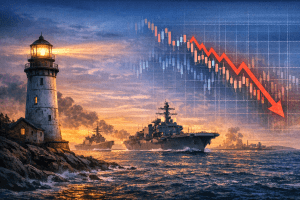
Today is no different. The entities that influence American policy—especially foreign policy—depend on one thing above all else: inflated asset values. Their wealth is not stored in factories, land, or productive capacity. It is stored in the stock market. And because their influence over lawmakers is purchased with that wealth, a decline in the market, especially a crash, would destroy the very resources they use to shape national decisions.
If their wealth collapses, their influence collapses. And when their influence collapses, lawmakers become far more inclined to represent the people who elected them. This is the real pressure point in the current war effort.
Natural law makes the situation obvious. People often ask how I “know” the stock market is rigged. Natural law gives us the answer. If a group has both the power and the means to rig the market in its favor, why wouldn’t it? What force would stop them? What incentive would restrain them?
After fifty years of technical analysis, I recognize patterns that do not occur in free markets. Beginning in the early 2000s, the market began displaying behaviors that were impossible under natural trading conditions. The most obvious is this: the market now rises on low volume more easily than it rises on high volume. That cannot happen unless the buying pressure is artificial.
Intraday charts reveal the same thing. With rare exceptions, the market is manicured second by second. The “buy the dip” reflex—once considered reckless—is now a profitable strategy because the system is engineered to reward it. Traders buy the instant news is announced, not because the news justifies it, but because the pattern has been programmed into the market itself. These are not theories. They are observable facts.
The system began decades ago. The practice of centrally controlling the stock market started during the Reagan administration and has continued ever since, growing more sophisticated with each passing year. Rising asset values have replaced real economic growth as the engine of American GDP. Debt is created not to fund productivity, but to inflate asset prices. Who complains when their assets rise? Who objects when their retirement accounts swell? Who questions the mechanism behind the prosperity?
This is why panic erupts at the top whenever the market even hints at a correction. A bear market is not merely an economic event. It is a political threat. It endangers the wealth of the entities whose influence depends on inflated valuations. And that brings us to the war.
The public is told that the war against Iran is about the Strait of Hormuz. The narrative says the strait must remain open, that global energy flows depend on it, and that geopolitical stability requires American involvement. But this is not the true hierarchy of priorities.
If the stock market crashes, the Strait of Hormuz becomes secondary. If the market collapses, the war effort collapses with it. If the valuations of the powerful evaporate, their influence evaporates. The war is not sustained by national will. It is sustained by asset prices.
The entities that benefit from the conflict rely on a rising market to maintain their political leverage. Without that leverage, lawmakers revert to representing the voters who put them in office. The entire structure of influence shifts. This is why the market must be held up at all costs.
Artificial systems can be maintained for long periods, but not forever. When reality finally asserts itself, the correction is not gentle. It is decisive. A market built on debt, manipulation, and political necessity cannot rise indefinitely. And a war effort built on that same artificial foundation cannot continue once the foundation breaks.
When the market falls, the wealth of the influential disappears. Their political leverage collapses. Lawmakers regain independence. The war effort loses its financial engine. National priorities realign with public interest. This is not speculation. It is natural law.
Power behaves according to its nature. So does reality. And when the two collide, reality wins.
Stay in touch
Occasional reflections on mindfulness and intentional living.